


Real Estate, Real Impact

“It’s a real estate town,” he says. “There’s real estate everywhere. It’s been one of the driving factors of the Arizona economy as long as I’ve lived here.”
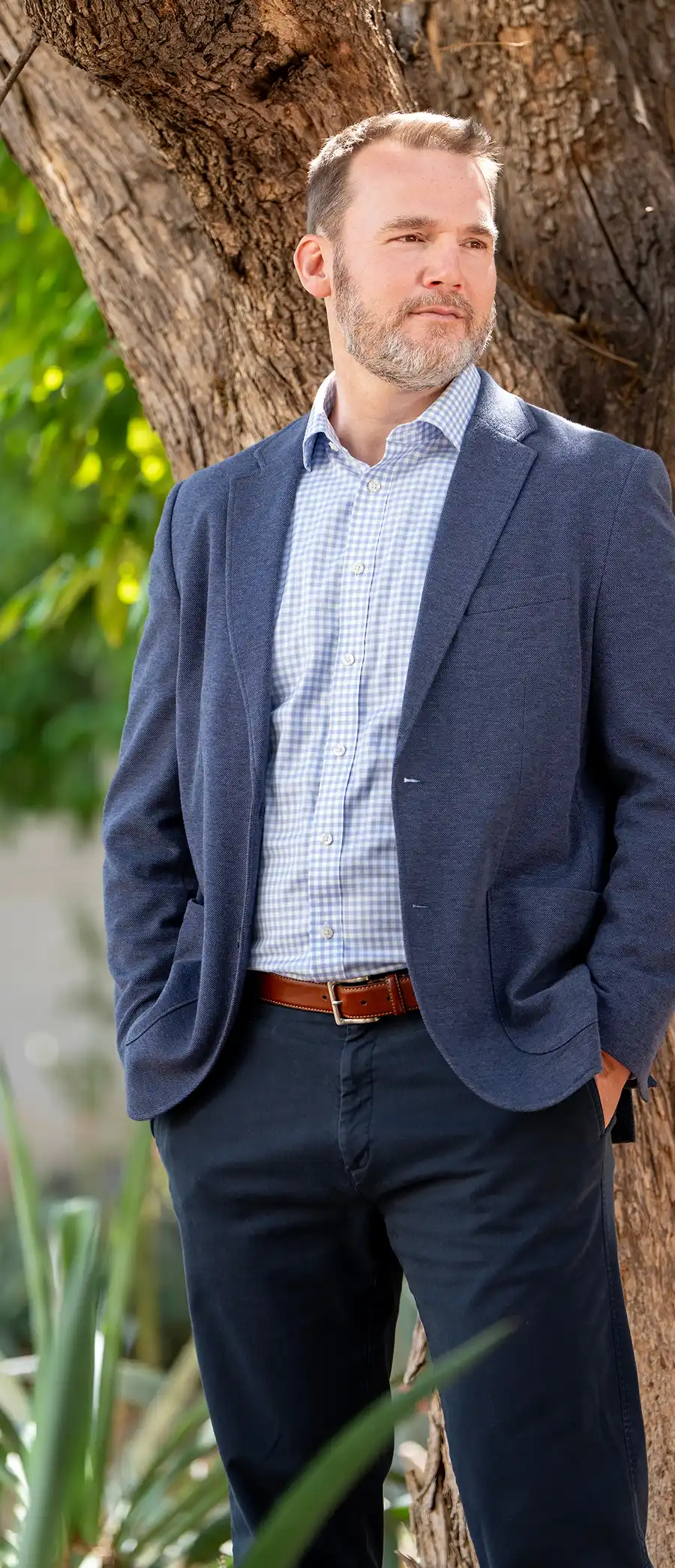
Today, Milligan is the CEO and managing partner of UDLR Healthcare, an investment management company that focuses on medical outpatient buildings. He founded UDLR with colleagues after selling their previous company, the publicly traded real estate investment trust Healthcare Trust of America. At the time of its sale in 2022, HTA was the largest owner and operator of medical outpatient buildings in the country; its properties encompassed more than 26 million square feet.
In recognition of his leadership in health care real estate, Milligan will be inducted into the W. P. Carey Alumni Hall of Fame in November 2025.
Finding a niche in health care real estate
Milligan himself found his way into REITs almost by chance: He was on the health care team when he joined Bank of America’s corporate investment bank in 2007. (Health care was another interest he absorbed in childhood — his father was a doctor and his mother was an occupational therapist.) The job took him all over the country, introducing him to almost every aspect of the health care sector, from pharmaceuticals and medical equipment to insurance. Still, Milligan discovered that medical real estate interested him most.
“Real estate is always tangible,” he says. “It’s something you can look at and touch and feel, and everybody interacts with it. And everybody goes to the doctor.” So in 2011, the same year he completed his MBA at the University of Chicago’s Booth School of Management, Milligan returned to Arizona to work for HTA.
He was excited when he learned a few years later that W. P. Carey planned to expand its real estate program, because he thought it would make Arizona a center of real estate investment and attract more local capital. It would also be a chance for local firms like his to develop and hire talented young people.
Milligan says during his years at W. P. Carey, one of the things he most enjoyed was meeting with industry professionals and learning how economic theories applied to real businesses. For his honors thesis on developing incentive compensation plans, he worked with a Ford Motor Co. call center to design an incentive compensation plan. “What I took from my time at W. P. Carey,” he says, “is not just the focus on the academics and research but also on how you can apply that to the real world.”
Turning experience into opportunity for students
“It’s a great opportunity for students to get real-life exposure to both how REITs work and how institutional capital works within the real estate investment space, but also to get that practical experience of investing in REITs and putting money to work in a much more hands-on way,” Milligan says.
The course lasts two semesters and meets once a week. Admission is by application, so the program can responsibly steward real investment capital and provide intensive coaching. Finance Professor of Practice Blair Koblenz, a former real estate investment professional who has taught the class since its inception, typically selects a small cohort of about 15 students each year. To broaden access, guest talks tied to the practicum are open to the wider student community, and interested students can apply annually.
For the first half of the year, students learn how to underwrite REITs and valuate the existing portfolio through lectures from Koblenz and guest speakers, including Milligan. A highlight is a trip to New York over fall break in October, when they meet with
W. P. Carey alums — including Milligan, who one year dispensed business advice on a rooftop with views of the Empire State Building — and leaders of W. P. Carey Inc., as well as representatives of the ratings agencies and some of the world’s largest investment firms, including BlackRock, Blackstone, Cohen & Steers, and J.P. Morgan.
“It’s not every day that students, especially students from ASU, get to meet with C-suite executives of billion-dollar companies,” Milligan says.
A high-stakes education with real capital
Milligan isn’t worried about entrusting the students with that much money. “They’re smart kids,” he says. “It’s also a pretty stable investment.”
At the end of the year, each student formally presents a stock they’ve been underwriting and recommends whether or not to buy. The audience includes not just their classmates and other students interested in taking the class next year, but also more than a dozen industry professionals who, says Koblenz, ask pointed questions and then vote on whether they agree with the students’ recommendations.
“It’s a very high-pressure situation,” Koblenz says. “It’s not just understanding your pitch and getting that done, it’s handling the questions and answers with these outside professionals, these CEOs and other investment people.”
Koblenz is unaware of any other college class quite like this one.
For Milligan, the REIT Portfolio Practicum is a chance to give back to his community. “ASU is a multiplier,” he says. “If you invest in that, you get a better education, which leads to better employees and attracts better companies and capital to where we want to be. It’s amazing to see how far the ASU real estate program has come.”
 There’s real estate everywhere. It’s been one of the driving factors of the Arizona economy as long as I’ve lived here.
(BS Economics/Finance ’03)